
A surge arrester is the single most important device protecting a substation or distribution line from lightning and switching overvoltages. A modern metal oxide surge arrester (MOA) does this with a zinc-oxide (ZnO) varistor block that conducts almost no current at normal voltage, yet instantly becomes highly conductive when voltage rises above a threshold — diverting the surge to ground and then resealing itself. This guide explains how MOAs work, which ratings actually matter, what IEC 60099-4 requires, how polymer and porcelain housings compare, and how to size an arrester for an 11 kV or 33 kV system.
In a hurry? Jump to Key Electrical Ratings, IEC 60099-4 Tests, or How to Select an Arrester.
What Is a Metal Oxide Surge Arrester?
A metal oxide surge arrester is a gapless protective device whose core is a column of zinc-oxide varistor discs. Unlike older silicon-carbide (SiC) arresters, which required a series spark gap to block the continuous operating voltage, an MOA relies entirely on the strongly non-linear voltage-current characteristic of ZnO ceramics.
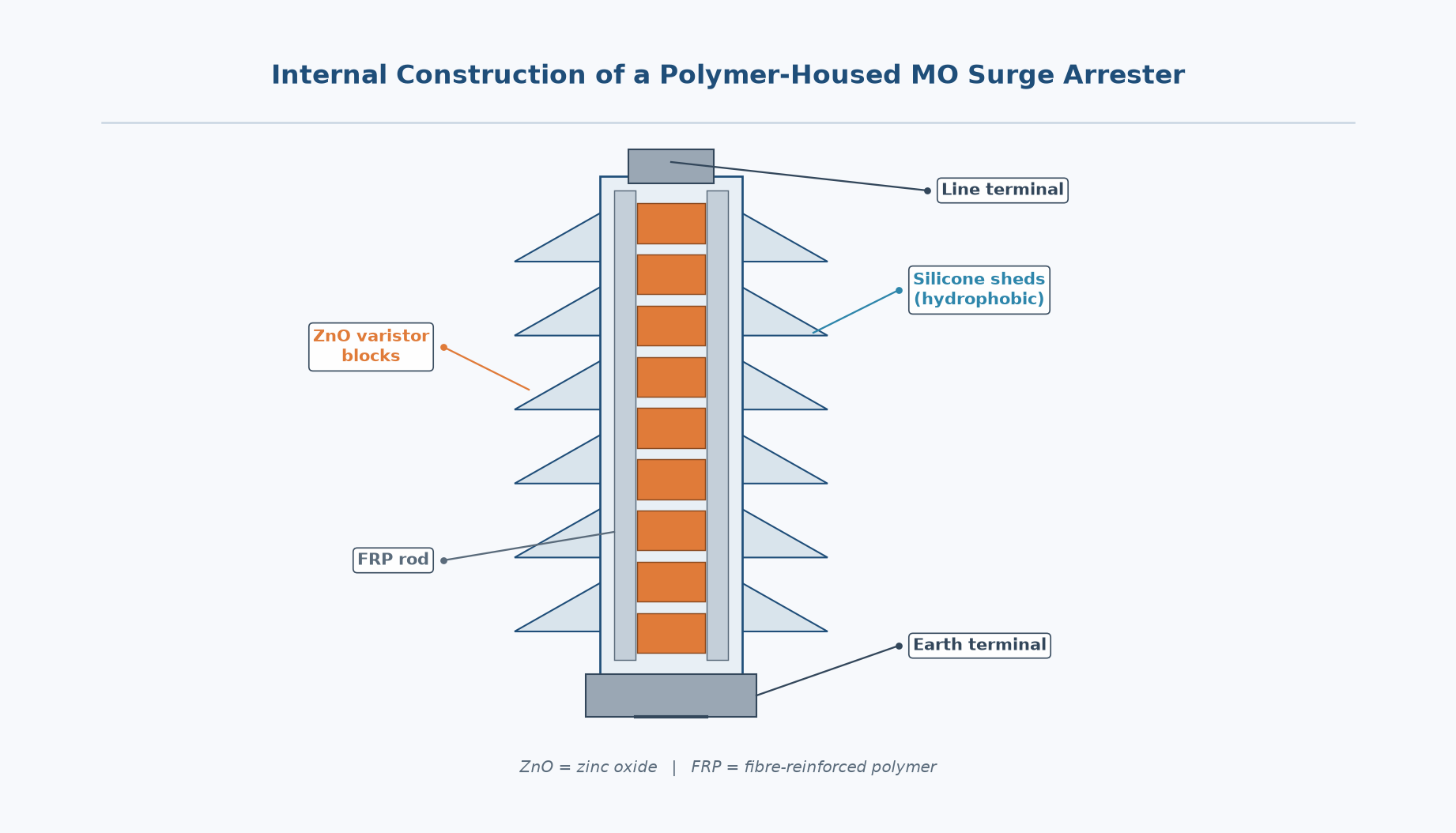
How the ZnO varistor works
At normal system voltage, the varistor’s resistance is extremely high — only a small leakage current (typically under 1 mA) flows. When an overvoltage arrives, the resistance collapses by several orders of magnitude within nanoseconds, carrying the surge current (often thousands of amperes) to ground. Once voltage returns to normal, the block immediately returns to its high-resistance state, with no power-follow current and no spark gap to extinguish.
Why “gapless” matters
Removing the spark gap brings four practical benefits:
- Faster response — no gap breakdown delay, so steep-front lightning impulses are clamped earlier.
- Better protection margin — the residual (discharge) voltage is lower for the same protective level.
- No power-follow current — the arrester reseals instantly after the surge.
- Stable performance — no gap erosion over decades of operation.
Key Electrical Ratings You Must Understand
Selecting an arrester is mostly about getting four ratings right. Misreading them is the most common cause of premature failure.
| Rating | What it means | Why it matters |
|---|---|---|
| Uc / MCOV | Maximum Continuous Operating Voltage — the highest RMS voltage the arrester can withstand continuously | Must exceed the maximum system phase-to-ground voltage, including temporary overvoltage |
| Ur | Rated voltage — the 10 s power-frequency withstand voltage | Determines the arrester’s TOV capability; not the same as system voltage |
| TOV | Temporary Overvoltage capability — how long it tolerates elevated power-frequency voltage | Critical on ungrounded or resistance-grounded systems where fault voltage can persist |
| Energy absorption | Maximum surge energy (kJ/kV of Ur) the varistor can absorb without damage | Must cover the expected lightning and switching surge energy at the location |
A frequent mistake is choosing an arrester whose Ur simply matches the system voltage. In practice, Ur is selected from a standard table based on system grounding and the required MCOV — an arrester for a 33 kV effectively-grounded system typically has Ur around 30–36 kV, not “33 kV”.
Deep dive: → Understanding Surge Arrester Electrical Ratings: MCOV, Rated Voltage, TOV and Energy Absorption
IEC 60099-4: What the Standard Actually Requires
IEC 60099-4 — Surge arresters — Part 4: Metal-oxide surge arresters without gaps for a.c. systems — is the governing international standard. (The older IEC 60099-1 covers gap-type SiC arresters and is largely superseded for new installations.)
Type tests vs routine tests
Type tests are performed once on a design to prove it meets the standard. The main ones include:
- Power-frequency voltage tests and reference voltage measurement
- Impulse current withstand (high-current 4/10 µs and low-current 30/60 µs impulses)
- Operating duty test — the most severe test, combining power-frequency TOV with lightning and switching impulses
- Short-circuit withstand (pressure relief / fault behaviour)
- Creepage distance and environmental tests
Routine tests are performed on every single unit before shipment. Per IEC 60099-4 Clause 9.1, these typically include measurement of reference voltage, leakage current at MCOV, and inspection of seals and assembly. When you buy arresters, always request the routine test certificate for your specific serial numbers — not just a generic type-test report for the model.
Deep dive: → Surge Arrester Type Tests: What IEC 60099-4 Really Demands
What to check in a third-party type-test report
Not all “type-test reports” carry the same weight. Look for:
- An accredited laboratory (KEMA, CQC, or equivalent ISO/IEC 17025 body).
- The exact model and Ur/MCOV matching what you are buying.
- Residual voltage values at the rated discharge current.
- Operating duty and short-circuit test results with passing status.
Polymer-Housed vs Porcelain-Housed: Which to Choose
The housing protects the varistor column from moisture and pollution and provides creepage distance. The two dominant technologies behave quite differently in the field.
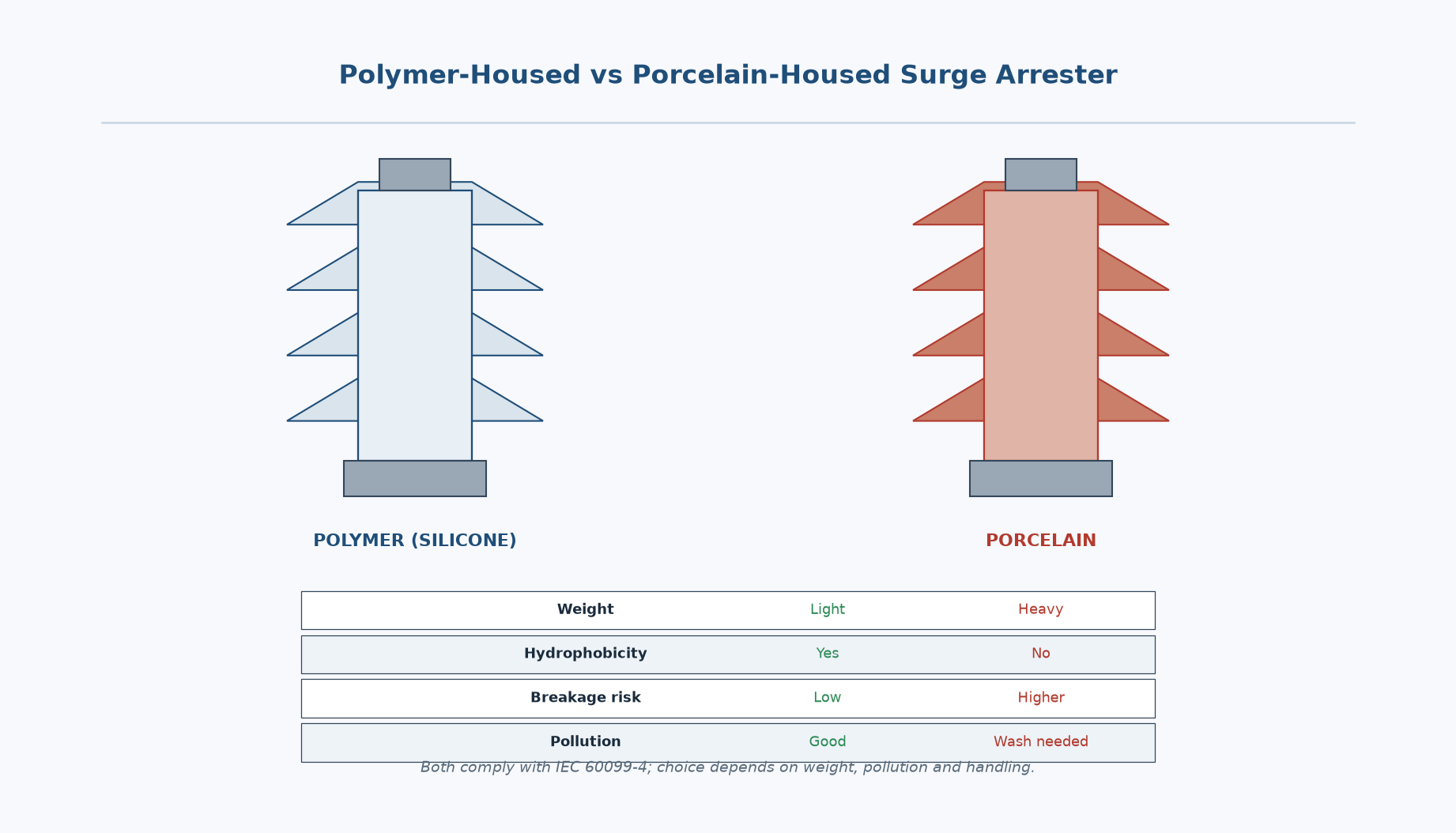
| Factor | Silicone rubber (polymer) | Porcelain |
|---|---|---|
| Weight | ~40–60% lighter | Heavy |
| Hydrophobicity | Intrinsically hydrophobic; transfers to pollution layer | Hydrophilic — wet pollution conducts |
| Pollution performance | Excellent; less cleaning | Needs washing in polluted/coastal areas |
| Breakage | Will not shatter; vandalism-resistant | Can crack or shatter |
| UV / ageing | Good with quality compound; tracked by many utilities | Very long proven track record |
| Cost | Competitive, especially at HV | Higher installed cost at HV |
For coastal, industrial, or heavily polluted environments, a silicone-housed arrester is usually the better long-term choice because its hydrophobicity dramatically reduces leakage current and flashover risk. Porcelain remains a valid choice where mechanical robustness and a very long service history are prioritised.
Deep dive: → How to Select the Right Surge Arrester Housing: Silicone Rubber vs Porcelain
How to Select an Arrester for 11 kV & 33 kV Systems
Use this five-step process:
- Confirm system parameters — nominal voltage, highest voltage (Um), neutrale grounding method (effectively grounded, resistance grounded, isolated), and short-circuit level.
- Determine required MCOV (Uc) — for grounded systems, typically Um/√3 × 1.0–1.1; for ungrounded systems, the full line-to-line voltage may appear to ground during a fault, so Uc must be much higher.
- Pick Ur from the standard table — choose the lowest Ur whose MCOV and TOV capability satisfy step 2; lower Ur means lower residual voltage and better protection.
- Verify energy capability — confirm kJ/kV of Ur covers the lightning/switching energy for the site (higher at exposed substations and cable-connected systems).
- Select housing and creepage — silicone for polluted/coastal sites; choose creepage distance (mm/kV) to match the site pollution severity per IEC 60815.
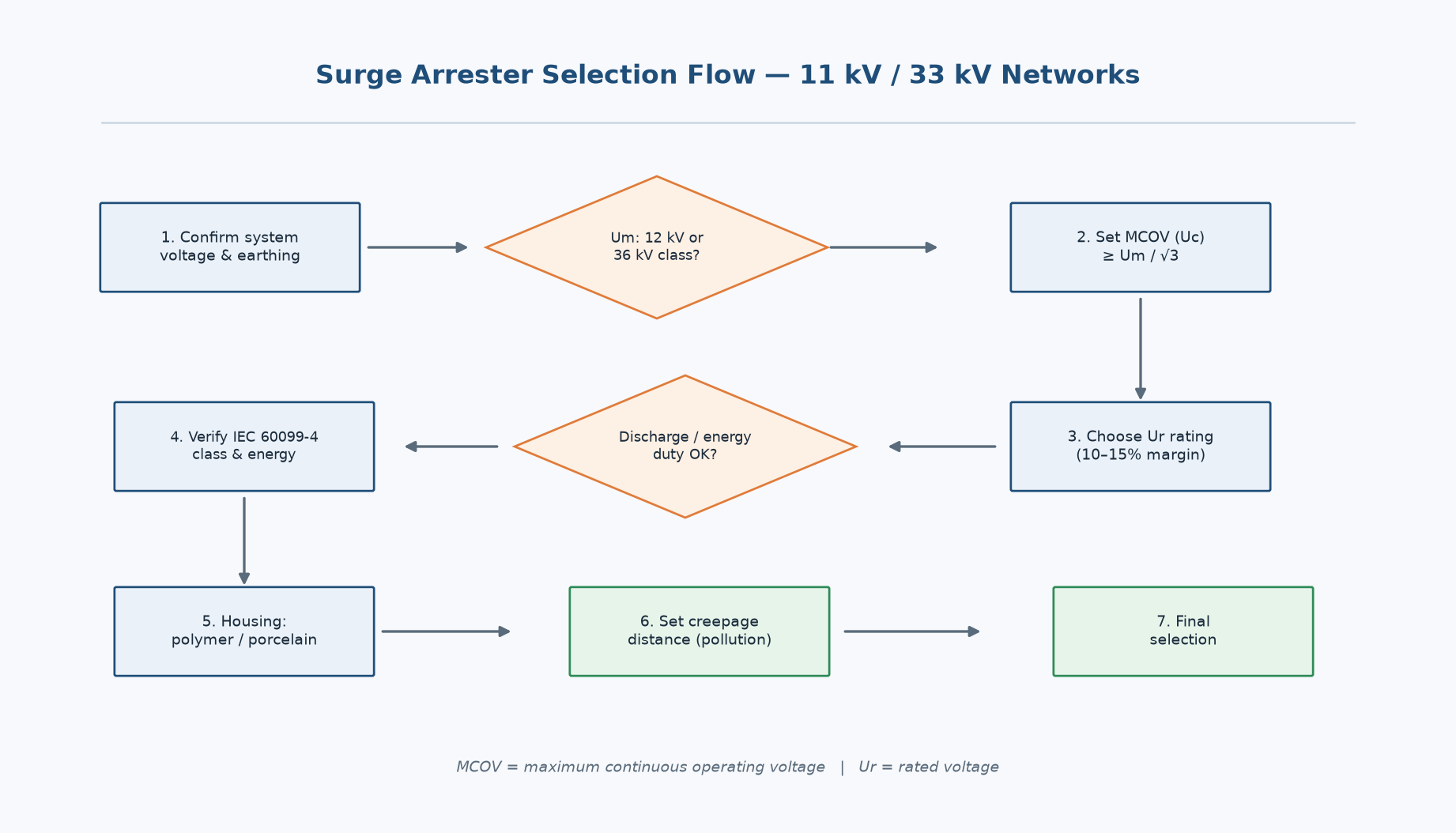
Worked example: For a 33 kV effectively grounded distribution substation, a common selection is Ur ≈ 36 kV with MCOV ≈ 28–29 kV and a silicone-housed design. For an 11 kV system, Ur ≈ 12 kV with MCOV ≈ 9–10 kV. Always verify against your utility’s grounding practice.
Deep dive: → How to Choose the Right Arrester for Your System
Installation, Commissioning & In-Service Monitoring
Correct installation is as important as correct selection:
- Mount the arrester as close as possible to the equipment it protects — lead length adds inductive voltage drop that reduces protection margin.
- Ensure the earth connection is short, direct, and low-impedance; a poor ground defeats the arrester.
- Check the discharge counter / leakage monitor is correctly connected and readable.
- After installation, measure reference voltage and leakage current to establish a baseline.
Over its life, monitor leakage current and use diagnostic techniques to detect moisture ingress or varistor degradation.
Further reading:
→ Installation & Commissioning Best Practices for Surge Arresters ·
→ Condition Assessment and Diagnostic Testing Methods for Surge Arresters ·
→ Common Failure Modes & Root Cause Analysis of Metal Oxide Surge Arresters ·
→ Aging Mechanisms and Service Life Prediction of Polymer-Housed Surge Arresters
Frequently Asked Questions
What is the difference between MCOV and rated voltage (Ur) of a surge arrester?
MCOV (Uc) is the maximum RMS voltage the arrester can withstand continuously without degradation. Rated voltage (Ur) is the power-frequency voltage the arrester can withstand for 10 seconds after absorbing energy — it defines the TOV capability. Ur is always higher than MCOV; you select Ur from a table so that its MCOV exceeds your system’s maximum operating voltage.
Which IEC standard governs metal oxide surge arresters, and what tests does it require?
IEC 60099-4 governs gapless metal oxide arresters for AC systems. It defines type tests (impulse withstand, operating duty, short-circuit, power-frequency) and routine tests on every unit (reference voltage, leakage current, seal inspection per Clause 9.1).
Should I choose a polymer-housed or porcelain-housed surge arrester for a coastal substation?
For coastal or polluted sites, polymer (silicone rubber) is usually preferred: its hydrophobic surface drastically reduces wet pollution leakage and flashover risk, it will not shatter, and it is much lighter. Porcelain is an option where a very long mechanical track record is the priority and pollution is mild.
How do I select the correct surge arrester for a 33 kV distribution line?
Confirm the grounding method, calculate the required MCOV, then choose the lowest Ur whose MCOV and TOV capability fit — typically Ur ≈ 30–36 kV for an effectively grounded 33 kV system. Verify energy absorption, then choose housing and creepage distance for the pollution level.
How often should surge arresters be tested or inspected in service?
Perform a visual and leakage-current check at least annually (more often in polluted areas), and a full diagnostic (reference voltage, resistive leakage current, or offline measurements) every 3–5 years or after a suspected severe surge event.
Specification Checklist & Request a Quote
Before requesting a quotation, have this information ready:
- [ ] System nominal voltage and highest voltage (Um)
- [ ] Neutral grounding method
- [ ] Required MCOV / Ur
- [ ] Short-circuit level and required energy class
- [ ] Housing material (silicone / porcelain) and pollution level
- [ ] Creepage distance requirement
- [ ] Quantity and delivery terms
XinNeng manufactures IEC 60099-4 compliant metal oxide surge arresters for 11 kV, 33 kV and higher voltage systems, with third-party type-test reports and routine test certificates available on request.
→ Request a Quote: Contact our sales team or email xn@xin-neng.com
→ Browse products: Polymer lightning arresters · Surge arrester product range