
Without systematic condition monitoring, a degrading surge arrester will fail without warning at the worst possible moment.
Table of Contents
Key Points: What You’ll Learn
- Resistive leakage current (Ir) is the most sensitive online indicator of ZnO block health — a 50% increase from baseline signals a warning, and a 100% increase triggers an alarm requiring immediate investigation.
- Baseline data recorded at installation is essential — trend analysis detects degradation far earlier than absolute thresholds; without baselines, one-off measurements provide limited diagnostic value.
- A complete condition assessment program requires three complementary approaches: online monitoring (continuous insight), offline U1mA testing (definitive diagnosis during outages), and visual inspection (external damage detection).
- Condition-based maintenance supported by trend analysis can extend arrester service life by 20–40% compared to time-based replacement while significantly reducing unplanned outages.
- Arresters older than 25 years should be considered for proactive replacement regardless of diagnostic values — polymer housing and seal integrity degrade independently of ZnO block condition.
1. What Condition Data Your Maintenance Program Needs to Collect
Metal-oxide surge arresters (MOSAs) operate silently—24 hours a day, 365 days a year—with no moving parts and no visible indicators of internal health. This “silent degradation” makes systematic data collection the only reliable way to detect incipient failure before a surge event exposes a weakened arrester.
A robust maintenance program begins with establishing baseline values for every arrester upon installation. Trend analysis, not absolute values, delivers the earliest warnings. The five parameters below form the core dataset that every utility should collect.
Resistive Leakage Current (Ir)
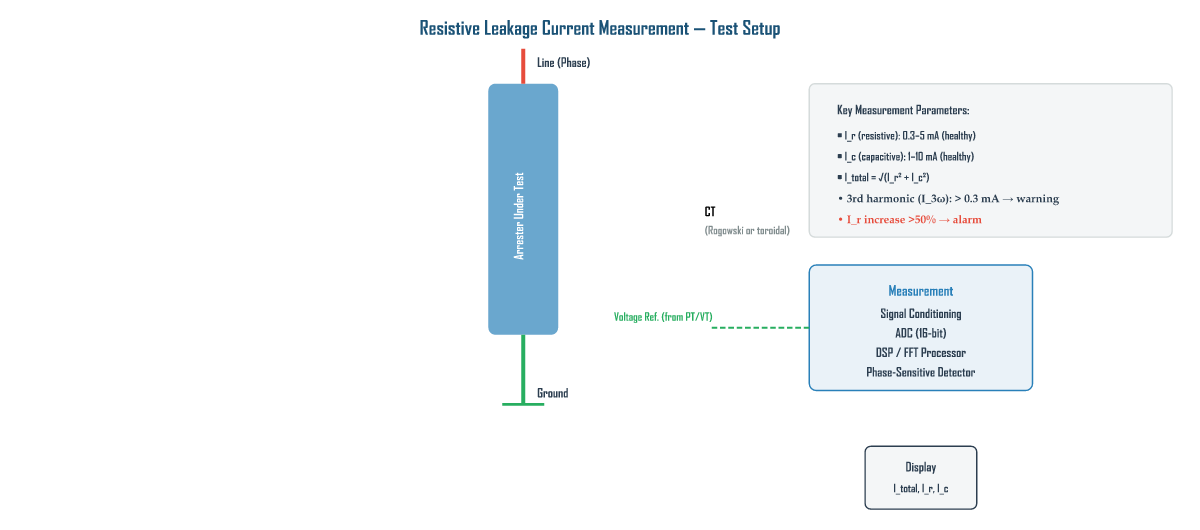
The resistive component of leakage current is the most sensitive online indicator of ZnO block health. As grain boundaries within the metal-oxide varistor degrade, the voltage threshold for significant current flow drops, increasing Ir weeks or months before catastrophic failure. Modern monitoring systems use a Rogowski coil or low-power CT to measure total leakage current and extract Ir through phase-sensitive detection referenced to the system voltage.
Key baseline values: Healthy station-class arresters typically exhibit Ir below 2 mA. A resistive current increase of more than 50% from the initial (baseline) value is a warning sign; exceeding 100% increase triggers an alarm condition requiring immediate investigation.
Third-Harmonic Component (I3ω)
As varistor nonlinearity increases with aging, the third harmonic of the leakage current rises proportionally. Third-harmonic analysis is particularly valuable in polluted coastal or industrial areas, where total leakage current measurement may be dominated by capacitive surface currents caused by surface contamination. I3ω > 0.3 mA warrants a warning; values above 1.0 mA indicate critical degradation.
Reference Voltage (U1mA)
The DC voltage required to produce exactly 1 mA through the arrester—measured during offline testing—directly reflects the condition of the ZnO block stack. A decrease of more than 10% from the original factory value indicates significant block degradation or internal shorting. Offline U1mA measurement remains the definitive assessment method when a system outage is available.
Thermal Signature
A healthy arrester operating within its ratings maintains a nearly uniform temperature distribution along its length, typically only slightly above ambient. An elevated internal temperature, detectable via infrared thermography, signals excessive Ir or poor internal connections. Thermal imaging also detects hot spots at line and ground terminals—a common problem independent of ZnO block condition.
Caution: Thermal imaging yields misleading results under overcast skies, rain, or high wind. The external housing temperature may not reflect internal ZnO block temperature under these conditions. Perform thermal imaging on clear, dry days with low wind, at least 4 hours after sunrise.
Partial Discharge (PD) Activity
PD signals inside an arrester indicate voids, cracks, or contamination within the internal insulation system. Online PD monitoring uses high-frequency current transformers (HFCT) clamped onto the ground lead, or ultra-high frequency (UHF) sensors. PD monitoring is essential for GIS-installed arresters, where visual inspection and thermal imaging are impossible.
2. Evaluating Assessment Methods: Accuracy, Cost, and Practicality
No single diagnostic method provides a complete condition picture. The most reliable assessment combines complementary methods matched to your operational constraints, budget, and risk tolerance. The following evaluation frameworks help you select the right mix.
Online Methods: Continuous Insight Without Outages
Online (energized) diagnostic methods allow assessment without taking the arrester out of service. Resistive leakage current monitoring is the most widely adopted online technique, capable of detecting incipient ZnO degradation weeks before failure. Third-harmonic analysis adds sensitivity in polluted environments. Thermal imaging detects poor connections and thermal runaway conditions but requires favorable weather. Online PD monitoring is invaluable for GIS-installed units.
Accuracy: High for resistive current and third-harmonic methods when properly calibrated. Medium for thermal imaging (affected by weather and emissivity variations).
Cost: Medium for resistive current monitors; medium-high for thermal cameras; high for PD systems.
Practicality: Excellent for routine monitoring; resistive current monitors can be left in place permanently with IoT data transmission.
Offline Methods: Definitive Assessment During Outages
Offline (de-energized) testing delivers the most definitive condition data but requires a scheduled system outage. The DC reference voltage test (U1mA) is the fundamental offline test—simple, low-cost, and highly sensitive to ZnO block degradation. Insulation resistance testing detects moisture ingress. Capacitance and tan δ measurements reveal changes in dielectric properties.
Accuracy: Very high for U1mA and insulation resistance. High for capacitance/tan δ.
Cost: Low for U1mA and insulation resistance; medium for capacitance/tan δ test sets.
Practicality: Limited by outage availability. Best performed during scheduled maintenance windows every 5–10 years.
Visual Inspection: The First Line of Defense
Visual inspection is the simplest and most frequent assessment activity. Trained inspectors check for housing cracks, seal condition, corrosion of end fittings, pollution accumulation, and lightning counter readings. While visual inspection cannot detect internal ZnO block degradation, it remains essential for identifying external damage that compromises seal integrity and leads to moisture ingress.
Accuracy: Low for internal condition; high for external damage detection.
Cost: Very low.
Practicality: Excellent as a routine screening tool; should be performed annually or after major storms.
| Assessment Method | What It Detects | Sensitivity to Early Aging | Online/Offline | Relative Cost | Recommended Frequency |
|---|---|---|---|---|---|
| Resistive Leakage Current (Ir) | ZnO block degradation, moisture | High | Online (preferred) | Medium | Annually |
| Third-Harmonic (I3ω) | ZnO nonlinearity, early aging | High | Online | Medium | Annually |
| Reference Voltage U1mA | ZnO block degradation | Medium-High | Offline only | Low | Every 5–10 years |
| Thermal Imaging (IR) | Thermal runaway, poor connections | Medium | Online | Medium-High | Annually (or after storms) |
| Insulation Resistance | Moisture ingress, internal contamination | Low-Medium | Offline | Low | During outage |
| Partial Discharge (PD) | Internal voids, contamination | High | Both | High | Every 3–5 years |
| Visual Inspection | Housing damage, seal condition, pollution | None (internal) | Online | Very Low | Annually |
3. Building a Condition-Based Maintenance Program That Works in the Field
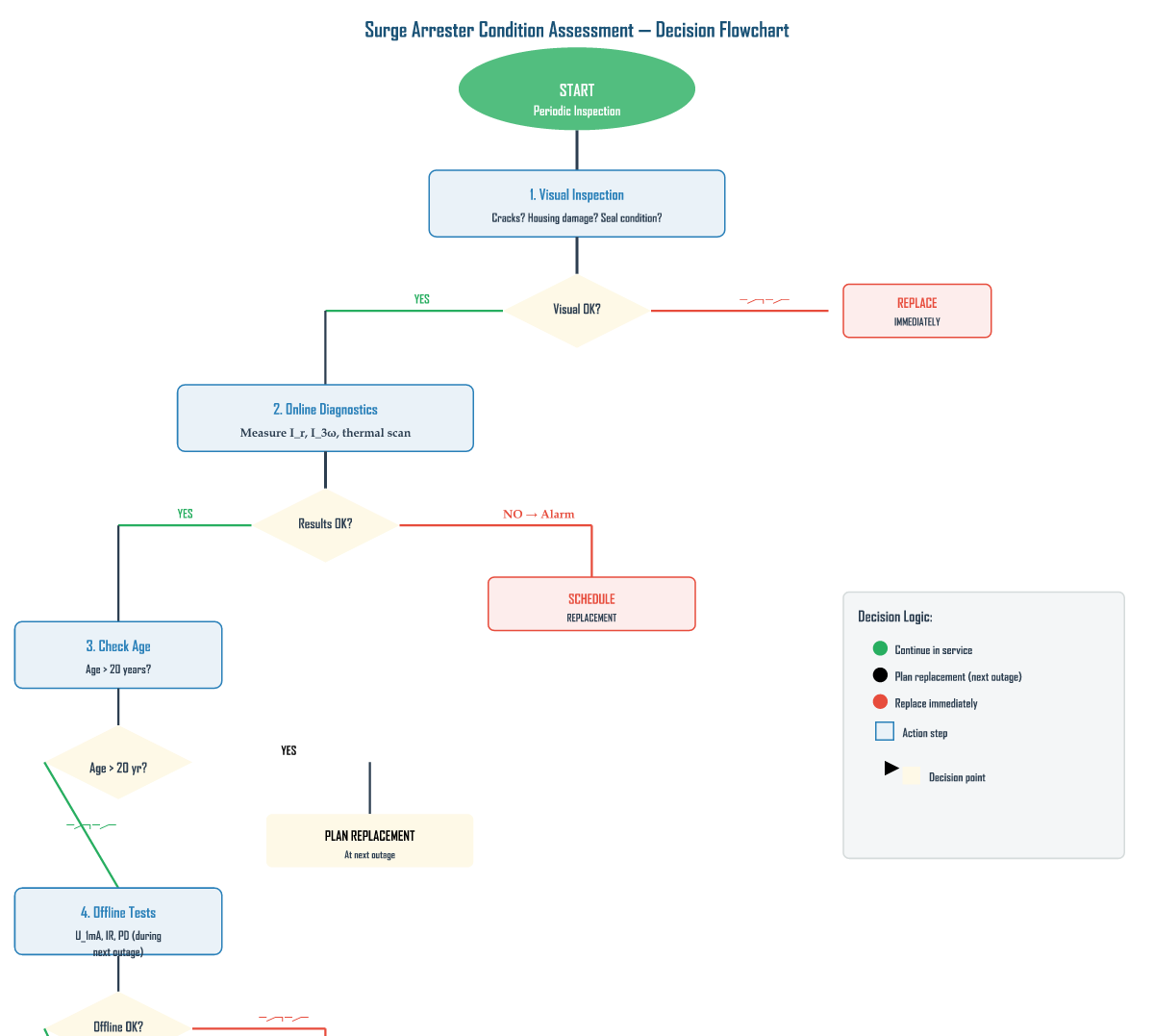
Condition-based maintenance (CBM) replaces time-based replacement with data-driven decisions, extending arrester service life by 20–40% while reducing forced outages. A successful CBM program rests on three pillars: data continuity, interpretation discipline, and clear replacement thresholds.
Establishing Baselines and Trends
The single most valuable action is recording baseline diagnostic values for each arrester at installation. Without baselines, absolute thresholds are your only reference—and they vary with arrester design, system voltage, and ambient conditions. Trend analysis detects degradation far earlier than one-off measurements. At a minimum, record the initial Ir, I3ω, and U1mA values, then re-measure annually for online parameters and every 5–10 years for offline parameters.
Setting Replacement Thresholds
The following interpretation guidelines, based on IEC 60099-4 and IEEE C62.11 recommendations, provide actionable thresholds for field decisions:
| Parameter | Healthy (Continue in Service) | Caution (Monitor Closely) | Alarm (Replace at Next Outage) | Critical (Replace Immediately) |
|---|---|---|---|---|
| Resistive Current Ir | < 2 mA (station class) | 2–5 mA | 5–10 mA | > 10 mA |
| Third Harmonic I3ω | < 0.2 mA | 0.2–0.5 mA | 0.5–1.0 mA | > 1.0 mA |
| U1mA (deviation from original) | Within ±3% | −3% to −7% | −7% to −15% | < −15% (or > +5%) |
| Insulation Resistance | > 10,000 MΩ | 1,000–10,000 MΩ | 100–1,000 MΩ | < 100 MΩ |
| Thermal Imaging (ΔT from ambient) | < 5°C | 5–15°C | 15–30°C | > 30°C |
| Partial Discharge | < 10 pC | 10–50 pC | 50–200 pC | > 200 pC |
Important: The thresholds above are general guidelines. Specific replacement criteria should be established based on the arrester manufacturer’s recommendations, the criticality of the protected equipment, and the consequences of arrester failure. For arresters protecting critical transformers, apply more conservative (tighter) thresholds.
Integrating Smart Monitoring Systems
The latest trend in CBM is the deployment of integrated smart monitoring systems that measure resistive current, third harmonic, housing temperature, and ground lead current simultaneously. These systems transmit data via cellular IoT or fiber optic links to a central asset management platform, enabling continuous condition tracking without site visits. For substations with critical transformers or in areas with high lightning density, smart monitoring delivers an outstanding return on investment by preventing unplanned outages.
Age as a Secondary Criterion
Even with good diagnostic data, age remains a useful secondary input. Arresters older than 25 years should be considered for proactive replacement, even if diagnostic values remain within acceptable limits. Polymer housing materials degrade independently of the ZnO blocks, and seal integrity deteriorates over decades. A risk-based approach weighs the cost of proactive replacement against the consequence of failure for each unit.
Field implementation checklist:
- Record baseline Ir, I3ω, and U1mA at installation for every arrester.
- Perform online resistive current measurement annually; thermal imaging after major storms.
- Perform offline U1mA and insulation resistance tests every 5–10 years during scheduled outages.
- Replace arresters when Ir exceeds 5 mA or I3ω exceeds 0.5 mA, even if other parameters are acceptable.
- Proactively plan replacement for all arresters exceeding 25 years of service.
4. Online Monitoring vs. Offline Testing vs. Visual Inspection: Which Approach Fits Your Operation?
Selecting the right assessment strategy depends on your substation criticality, maintenance budget, outage flexibility, and risk tolerance. Many utilities adopt a hybrid approach: annual visual inspection for all units, online monitoring for critical substations, and offline testing during scheduled outages for units approaching 15+ years of service.
| Assessment Approach | Best For | Detects Internal Aging? | Requires Outage? | Cost per Arrester | Recommended Role in CBM |
|---|---|---|---|---|---|
| Online Monitoring (Resistive current, I3ω) | Critical substations, coastal/high-pollution areas | Yes (early stage) | No | Medium-High (initial), Low (ongoing) | Primary screening for critical assets |
| Online Thermal Imaging | Routine inspections, post-storm assessments | Only advanced (thermal runaway) | No | Medium (equipment cost) | Complementary; detects connections and thermal issues |
| Offline U1mA Test | Units >15 years old, during scheduled outages | Yes (definitive) | Yes | Low | Definitive assessment when outage is available |
| Offline Insulation Resistance | suspected moisture ingress, post-flood | Indirect (moisture only) | Yes | Very Low | Targeted use for moisture investigation |
| Visual Inspection | All arresters, all locations | No | No | Very Low | First-line screening; identifies external damage |
| Integrated Smart Monitoring | Large fleets, remote substations | Yes (continuous) | No | Medium-High | Ideal for fleets >100 arresters; enables centralized CBM |
The optimal strategy for most utilities is a three-tier program: Tier 1—annual visual inspection for all units; Tier 2—online resistive current monitoring for arresters protecting critical transformers or located in high-lightning-density areas; Tier 3—offline U1mA and insulation resistance testing during scheduled outages for units aged 15+ years. This approach balances cost, risk, and diagnostic value while building a multi-year dataset for trend-based decisions.
5. Summary
- Pain point: Without systematic condition monitoring, a degrading surge arrester will fail without warning at the worst possible moment.
- Finding 1: Resistive leakage current (Ir) and third-harmonic analysis are the most sensitive online methods for detecting incipient ZnO block degradation weeks before failure.
- Finding 2: A complete condition assessment program combines online monitoring (for continuous insight), offline testing (for definitive diagnosis during outages), and visual inspection (for external damage detection).
- Finding 3: Condition-based maintenance, supported by baseline data and trend analysis, can extend arrester service life by 20–40% compared to time-based replacement, while significantly reducing unplanned outages.
- Comparison conclusion: Online monitoring delivers the best early-warning capability without outages; offline U1mA testing provides the most definitive assessment when an outage is available; visual inspection is essential but cannot detect internal aging.
Get Your Custom Surge Arrester Solution
Need help selecting the right diagnostic program for your surge arresters? Our engineering team provides free technical consultation based on your system parameters and operational constraints.
Or visit www.xin-neng.com to browse our full product catalog.
About Xin-Neng Electric
Xin-Neng Electric is a leading manufacturer of high-voltage electrical equipment, specializing in surge arresters, drop-out fuse cutouts, and composite insulators for power transmission and distribution systems worldwide.
Contact: xn@xin-neng.com | www.xin-neng.com
Frequently Asked Questions
What condition data should a surge arrester maintenance program collect?
Resistive leakage current, housing surface temperature, partial-discharge activity, and visual signs of tracking or seal failure.
How do online monitoring and offline testing compare?
Online monitoring captures continuous trends and gradual aging; offline testing (megger, capacitance) gives point-in-time diagnosis. A mixed program is most robust.
Which diagnostic method is most cost-effective?
Visual inspection is cheapest but least sensitive; infrared thermography offers good cost/accuracy for hot spots; resistive leakage-current measurement is sensitive to aging at moderate cost.
How do I build a condition-based maintenance program?
Define asset criticality, set inspection intervals by risk, deploy online sensors on key assets, and trigger intervention when resistive current or temperature exceeds predefined thresholds.