
Surge Arrester Selection Guide: How to Choose the Right Arrester for Your System
Selecting the wrong surge arrester can lead to catastrophic equipment failure during the first major overvoltage event.
Table of Contents
Key Points: What You’ll Learn
- Understanding the relationship between system voltage, MCOV, and rated voltage is the foundation of proper selection.
- Temporary overvoltage (TOV) capability must exceed the maximum expected overvoltage duration and magnitude.
- Energy handling capability (kJ/kV) determines survival during multi-stroke lightning events.
- Housing material selection (silicone vs. porcelain) significantly impacts maintenance and pollution performance.
- Third-party type tests per IEC 60099-4 or IEEE C62.11 are non-negotiable for critical installations.
1. Identifying Your System’s Voltage and Insulation Level
The first step in any arrester selection process is defining the electrical environment. This foundational data determines every subsequent rating.
System Voltage (Ur system)
Whether you are working with 11 kV distribution lines or 800 kV HVDC transmission, the system’s nominal voltage is your starting point. However, the arrester’s rated voltage (Ur) must be higher than the system’s maximum continuous operating voltage (MCOV).
Example: For a 132 kV system with a maximum operating voltage of 145 kV, you would typically select an arrester with Ur = 120 kV or 144 kV, depending on the neutral grounding method.
| System Voltage (kV) | Max. Operating Voltage (kV) | Recommended Arrester Ur (kV) | Typical MCOV (kV) |
|---|---|---|---|
| 11 | 12 | 9 – 10 | 7.5 – 8.5 |
| 33 | 36 | 27 – 30 | 22 – 25 |
| 66 | 72 | 54 – 60 | 45 – 50 |
| 132 | 145 | 108 – 120 | 90 – 100 |
| 220 | 245 | 180 – 204 | 150 – 170 |
| 400 | 420 | 320 – 360 | 260 – 300 |
MCOV (Maximum Continuous Operating Voltage)
MCOV is the maximum voltage the arrester can withstand continuously without exceeding its duty cycle. This is not the same as the rated voltage (Ur), which includes a safety margin.
Insulation Level (BIL / SIL)
Your arrester’s protective level (residual voltage) must be lower than the equipment’s Basic Insulation Level (BIL) or Switching Impulse Level (SIL). A common design target is:
- Arrester protective level ≤ 0.83 × BIL (for IEEE regions)
- Arrester protective level ≤ 0.75 × BIL (for IEC regions, more conservative)
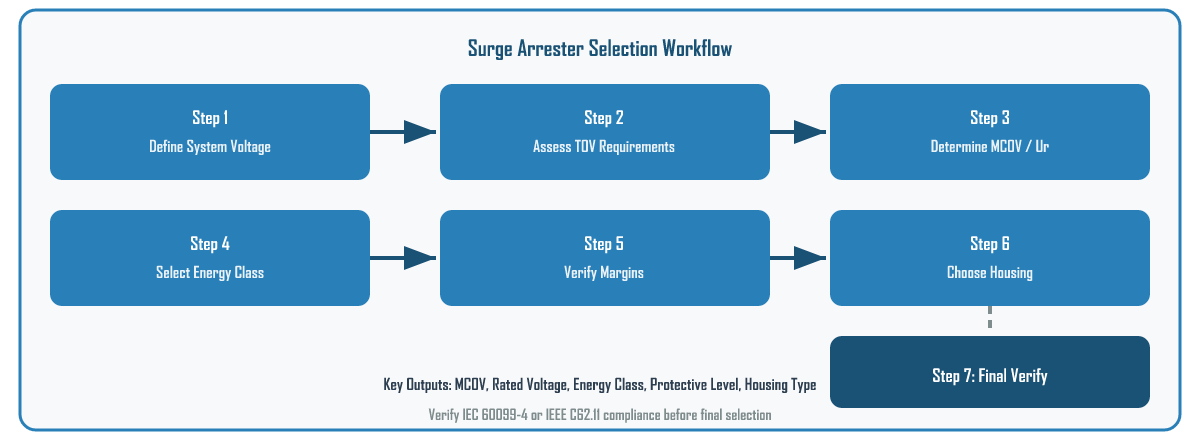
Figure 1: Step-by-step surge arrester selection workflow from system definition through final verification
2. Matching Arrester Ratings to Your System’s Needs
Temporary Overvoltage (TOV) Capability
TOV occurs when the system experiences a fault or switching transient that raises voltage above normal levels for seconds to minutes. The arrester must withstand this without thermal runaway.
| System Type | Typical TOV (per-unit) | Required Arrester TOV Capability | Notes |
|---|---|---|---|
| Effectively grounded | 1.2 – 1.4 p.u. | ≥ 1.4 × Ur | Most common for transmission |
| Ungrounded / weakly grounded | 1.5 – 2.0 p.u. | ≥ 2.0 × Ur | Requires special arresters |
| Resonant grounded | 1.73 p.u. | ≥ 1.73 × Ur | Distribution only |
| HVDC | Varies | As per IEEE C62.11 | Consult manufacturer |
Energy Discharge Capability (Seizure Class)
This is measured in kJ/kV of rated voltage and determines how much energy the arrester can absorb without failure. Higher seizure classes are required for areas with high lightning density.
| Seizure Class | Energy (kJ/kV) | Duty Level | Typical Environment |
|---|---|---|---|
| Class 1 | 2.5 | Light | Urban, well-shielded |
| Class 2 | 5.0 | Medium | Suburban, moderate lightning |
| Class 3 | 10.0 | Heavy | Rural, high lightning, exposed |
| Class 4 | 20.0 | Extra heavy | Mountaintop, UHV |
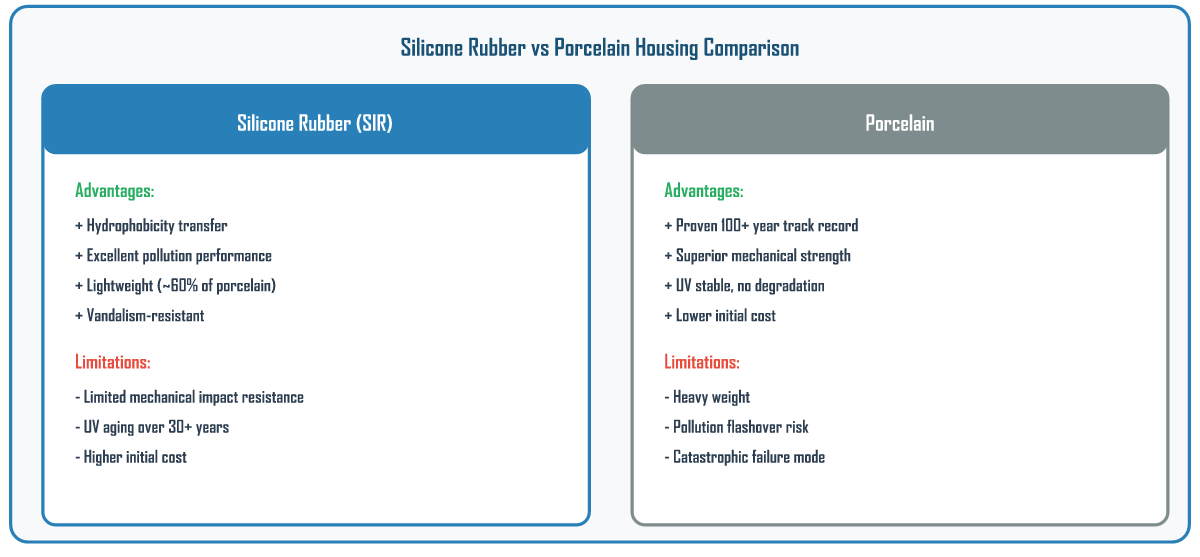
Figure 2: Silicone rubber vs porcelain housing comparison for arrester selection
3. Evaluating Environmental and Application-Specific Factors
Pollution Degree (IEC 60815)
Contamination on the arrester housing can cause flashover, defeating the protection. Use the correct Creepage Distance:
| Pollution Level | Description | Creepage Distance (mm/kV) | Typical Environment |
|---|---|---|---|
| Light | Rural, no industrial pollution | 16 – 20 | Farmland, residential |
| Medium | Moderate industrial or coastal | 20 – 25 | Suburban, light industry |
| Heavy | Industrial, coastal, desert | 25 – 31 | Steel mills, cement plants |
| Very Heavy | Severe industrial or coastal | 31 – 40 | Chemical plants, salt fog areas |
Housing Material: Silicone vs. Porcelain
The housing material affects both initial cost and lifecycle maintenance.
| Criteria | Silicone Rubber (SIR) | Porcelain | Winner |
|---|---|---|---|
| Weight | ~40% of porcelain | Heavy | Silicone |
| Pollution Performance | Excellent (hydrophobicity) | Poor (requires RTV coating) | Silicone |
| Impact Resistance | Good (polymeric) | Excellent | Porcelain |
| UV Resistance | Good (with proper formulation) | Excellent (inert) | Porcelain |
| Cost (initial) | Higher | Lower | Porcelain |
| Cost (lifecycle) | Lower (less maintenance) | Higher (washing required) | Silicone |
| Vandalism Risk | Low (no shards) | High (projectiles) | Silicone |
Altitude Correction
Above 1000 meters, air density drops, reducing the flashover voltage. Apply the correction factor:
Ka = 1 / (1.1 – H × 10-4) where H is altitude in meters.
Example: At 3000 m, Ka = 1.29. A 400 kV arrester must be specified with 29% higher external insulation (longer creepage or special design).
4. Verifying Compliance and Certifications
Before finalizing your selection, verify that the arrester meets the relevant standards.
Key Standards by Region
| Region | Primary Standard | Key Requirements |
|---|---|---|
| Global | IEC 60099-4:2014 | Type tests, ratings, dimensions |
| North America | IEEE C62.11-2012 | Similar to IEC, with US conventions |
| China | GB 11032-2020 | Based on IEC 60099-4 |
| Europe | EN 60099-4 | CE marking required |
Summary: Your Arrester Selection Checklist
- ☑ System voltage and MCOV correctly matched?
- ☑ TOV rating exceeds expected overvoltage by ≥ 20%?
- ☑ Energy class appropriate for lightning density and system type?
- ☑ Creepage distance sufficient for local pollution level?
- ☑ Housing material selected based on lifecycle cost, not just initial price?
- ☑ Third-party type test report available and verified?
- ☑ Altitude correction applied if installed above 1000 m?
- ☑ Arrester manufacturer has track record of ≥ 10 years in similar applications?
Ready to Find the Right Arrester for Your System?
At Xin-Neng, we manufacture surge arresters that meet IEC 60099-4 and IEEE C62.11 standards, with third-party type test reports from CEPRI and international laboratories. Our technical team can verify your selection against your specific system parameters.
Frequently Asked Questions
How do I choose the right surge arrester for my system?
Begin by identifying your system’s maximum continuous operating voltage (MCOV) and basic insulation level (BIL). Then match the arrester’s rated voltage and protective level, evaluate environmental and application-specific factors, and verify compliance with IEC 60099-4 or IEEE C62.11.
What is the difference between rated voltage and MCOV in a surge arrester?
MCOV is the highest continuous voltage the arrester can withstand without degradation. Rated voltage is the permissible continuous operating voltage that also covers expected temporary overvoltages (TOV). The rated voltage must exceed the system MCOV with adequate margin.
Which standards should a surge arrester comply with?
The two dominant standards are IEC 60099-4 (international) and IEEE C62.11 (North America). Both define rating systems, type tests, and classification; the applicable standard is normally dictated by the project’s specifying authority and target market.
Why is third-party certification important when selecting a surge arrester?
Independent type-test certifications (e.g., KEMA, CEPRI) confirm that the arrester meets its declared ratings and survives standardized surge, TOV, and energy-duty tests, materially reducing the risk of field failures.