
A high voltage disconnector (also called an isolator) is the device that creates a visible, reliable air gap in a circuit so equipment can be safely maintained. It does not interrupt load or fault current — that is the job of a circuit breaker. This guide explains what a disconnector does, the main design types (including the widely used GW4 double-break design), the ratings that matter, what IEC 62271-102 requires, and how to select one.
Jump to: What a disconnector does · Design types · Ratings · Standards · Selection · FAQ
What a Disconnector Does
A disconnector has one essential job: visible isolation. When open, it provides an air gap that can be visually confirmed, giving maintenance crews confidence that the downstream equipment is de-energised. Key points:
- It is operated only after the circuit breaker has opened and current is zero — it must not break load current.
- It carries normal current when closed and withstands fault current without damage (short-time withstand) until a breaker clears the fault.
- Some designs include an earthing switch that grounds the downstream side after isolation, for crew safety.
Because it provides the visible break that a breaker enclosed in a tank cannot, the disconnector is a fundamental safety device in substations and on overhead lines.
Design Types
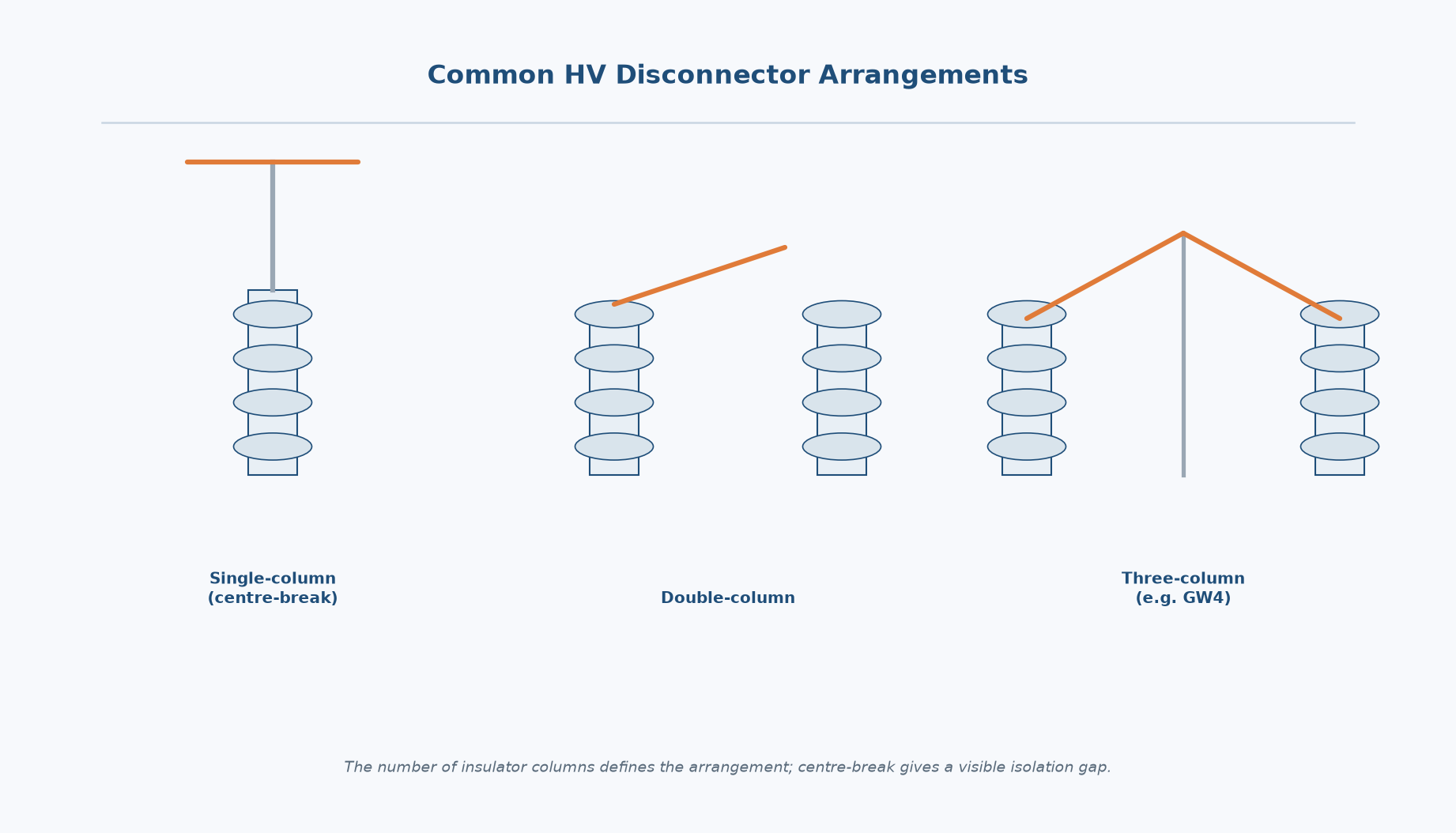
- Single-column (vertical-break / pantograph) — one post with a moving contact that swings or telescopes; compact, used where space is limited.
- Double-column (GW4 type) — two insulator columns, one or both rotate to open a central break. The GW4 double-break disconnector is one of the most widely used designs in 11–33 kV and higher substations: robust, clear visible gap, simple mechanism.
- Three-column (centre-break) — a central moving blade rotates between two fixed contacts; common at higher voltages.
Deep dive: → Disconnector GW4-40.5 Type Tests: Design and Verification
Key Ratings
| Rating | Meaning | Selection note |
|---|---|---|
| Rated voltage (kV) | System voltage class | Match to system (e.g. 33 kV, 40.5 kV) |
| Rated current (A) | Continuous current when closed | Must exceed maximum load current |
| Short-time withstand current (kA/s) | Fault current withstood without damage | Must match system fault level and duration |
| Peak withstand current (kA) | Peak of the fault current | Mechanical robustness check |
| Impulse withstand (BIL) | Lightning impulse insulation level | Coordination with system insulation |
| Creepage distance | Insulator surface path | Match to pollution level (IEC 60815) |
IEC 62271-102
Disconnectors and earthing switches are governed by IEC 62271-102. Type tests include:
- Dielectric tests (lightning impulse and power-frequency withstand, across the open gap and to earth)
- Temperature rise at rated current
- Short-time withstand and peak withstand current tests
- Mechanical operation tests (endurance, operating force/torque)
- Environmental tests (IP, corrosion, icing where relevant)
The open-gap dielectric test is particularly important — it proves the visible break also withstands the system voltage and overvoltages without flashover. Always request the type-test report for the exact model.
Selection Guide
- Confirm system voltage and fault level — drives rated voltage, withstand current and BIL.
- Choose the design type — GW4 double-column for general substations; single-column/pantograph where space is tight; three-column at higher voltages.
- Set rated current above maximum load with margin.
- Decide on earthing switch — add it where maintenance grounding is required.
- Match creepage to pollution — silicone or increased creepage for coastal/industrial sites.
- Verify operating mechanism — manual or motorised, interlocked with the associated breaker.
Frequently Asked Questions
What is a high voltage disconnector used for?
It creates a visible air gap to isolate equipment for safe maintenance. It does not interrupt load or fault current — it is operated only after the circuit breaker has opened.
What is a GW4 disconnector?
The GW4 is a widely used double-column, double-break disconnector design: two insulator columns with rotating blades that open a central gap. It is valued for its robust construction, clear visible break and simple mechanism, and is common in 11–33 kV and higher substations.
Can a disconnector be operated under load?
No. A disconnector must not break load or fault current. Operating it under load can cause a damaging arc. Always open the circuit breaker first, then the disconnector.
What does short-time withstand current mean for a disconnector?
It is the fault current the disconnector can carry for a specified time (e.g. 1 or 3 seconds) without thermal or mechanical damage, until a downstream protective device clears the fault.
Which IEC standard covers disconnectors?
IEC 62271-102 covers high-voltage AC disconnectors and earthing switches, including dielectric, temperature-rise, short-time withstand and mechanical endurance tests.
Request a Quote
XinNeng manufactures GW4 and other high voltage disconnectors for 11 kV–132 kV substations, with IEC 62271-102 type-test reports available.
→ Request a Quote: Contact our sales team or email xn@xin-neng.com
→ Browse products: Switch & Disconnector products · All products