
On overhead distribution networks, the drop-out fuse cutout is the workhorse of overcurrent protection. It does two jobs at once: it interrupts fault current by melting a fuse link, and it opens visibly — the fuse tube swings down — giving line crews a clear, isolatable break point. This guide explains the operating principle, the ratings that matter, polymer versus porcelain bodies, and how to select and install a cutout for 11 kV and 33 kV lines.
Jump to: How it works · Ratings · Polymer vs porcelain · Selection · FAQ
How a Drop-out Fuse Cutout Works
A cutout has three elements: an insulator body (polymer or porcelain), a hinge-mounted fuse tube, and a fuse link inside the tube.
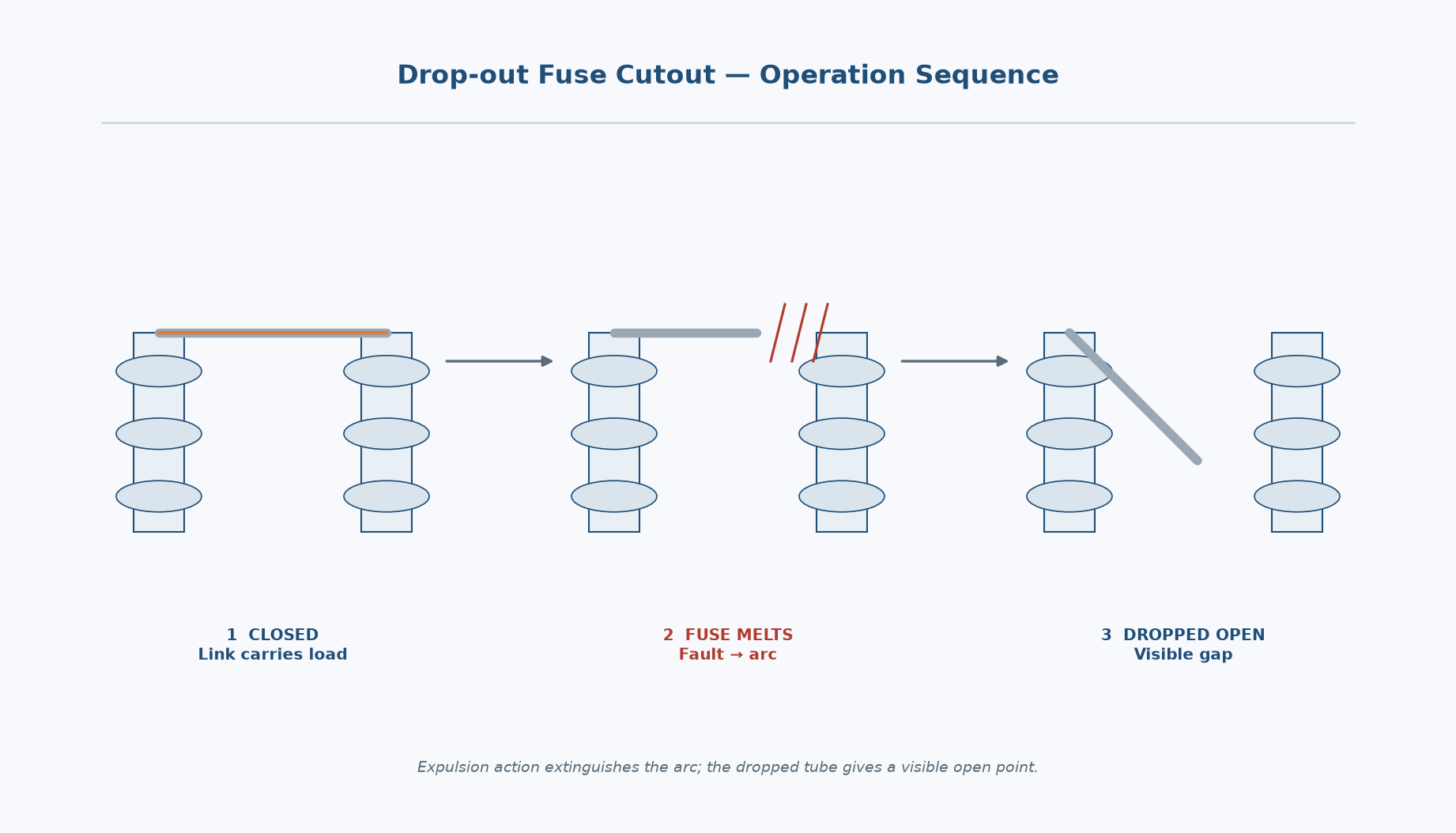
Under normal conditions, the fuse link carries load current and holds the tube closed. When a fault or overload occurs:
- The fuse link melts.
- An arc forms inside the tube. In an expulsion cutout, the arc vaporises the fibre/liner inside the tube, generating gas that blasts the arc out and extinguishes it at a current zero.
- With the link gone, the spring-loaded tube drops open on its hinge — creating a visible air gap and isolating the faulty section.
Deep dive: → Expulsion Drop-out Fuse Cutout: How It Works, Type Tests and Selection
Key Ratings: Rated Voltage, Current & Breaking Capacity
| Rating | Meaning | Why it matters |
|---|---|---|
| Rated voltage | The system voltage class (e.g. 11 kV, 33 kV) | Must match system; affects creepage and impulse withstand |
| Rated current | Maximum continuous current of the cutout and fuse holder | Must exceed normal load current |
| Fuse link rating | The melting current of the replaceable link (A) | Coordinated with load and downstream protection — not the same as cutout rated current |
| Breaking capacity | Maximum symmetrical fault current the cutout can safely interrupt (kA) | Must exceed the available short-circuit current at the installation point |
| Impulse withstand (BIL) | Lightning impulse voltage the open/closed cutout withstands | Part of line insulation coordination |
A common error is confusing the cutout rated current (e.g. 200 A) with the fuse link rating (e.g. 15 A). The cutout is the hardware; the link is the sacrificial, replaceable element chosen to protect the specific load — a transformer, a line section, or a capacitor bank.
Polymer vs Porcelain Fuse Cutout Bodies
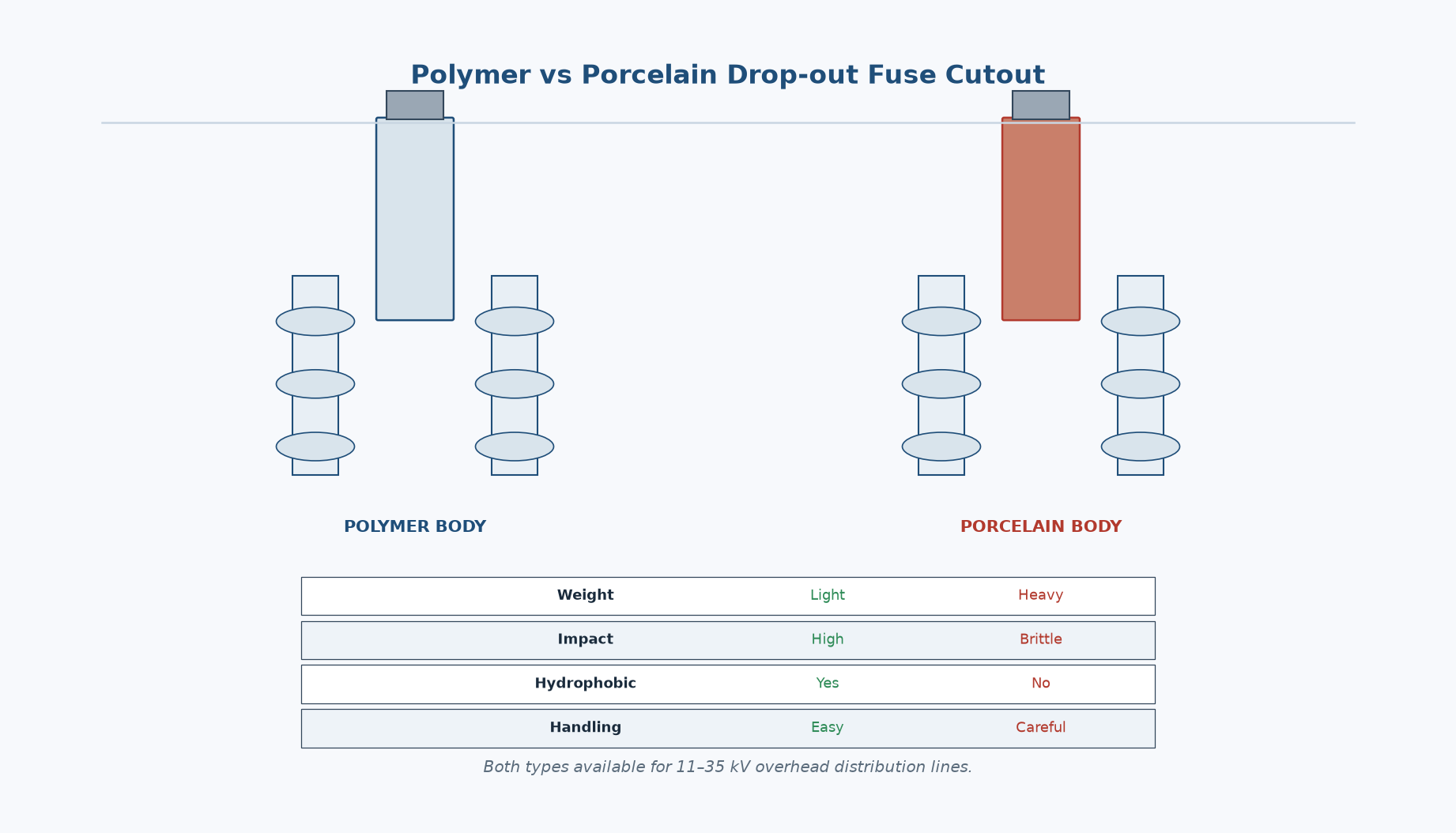
| Factor | Polymer (silicone) | Porcelain |
|---|---|---|
| Weight | Much lighter — easier single-person installation | Heavy |
| Breakage | Will not shatter; vandalism-resistant | Can crack or break |
| Pollution | Hydrophobic; good wet flashover performance | Needs cleaning in polluted areas |
| Ageing | Good with quality silicone compound | Long proven record |
| Cost | Competitive | Established, often lower at low voltage |
For rural and polluted distribution lines, polymer cutouts are increasingly preferred for their light weight and vandalism resistance. Porcelain remains common where cost and a long field history dominate.
Selecting a Fuse Cutout for 11 kV & 33 kV Lines
- Confirm system voltage and grounding — sets rated voltage and insulation level.
- Calculate available fault current at the point of installation — select a breaking capacity above it.
- Determine load current — select cutout rated current above the maximum normal load.
- Choose the fuse link rating — coordinate with the protected equipment and downstream protection so the link clears faults before the upstream device, but does not nuisance-blow on inrush or overload.
- Select body material and creepage — polymer for polluted/vandalism-prone sites; creepage per pollution severity.
Worked example: A 11 kV rural transformer feeder might use a 15 kV, 200 A cutout with a 25 A fuse link and a breaking capacity of 12–16 kA, polymer body for a coastal location.
Installation, Operation & Common Pitfalls
- Mount the cutout at a height and angle that allow safe operation with a hot stick.
- Ensure the fuse link is correctly sized and properly seated — a loose link causes heating and nuisance operation.
- Check the tube drops freely and the contacts make firm contact when closed.
- After an operation, always replace the fuse link and inspect the tube and contacts before re-energising.
- Common pitfalls: undersized breaking capacity, wrong link rating (nuisance blowing or failure to clear), and poor contacts causing overheating.
Frequently Asked Questions
How does an expulsion drop-out fuse cutout interrupt fault current?
When the fuse link melts, the arc inside the fibre-lined tube vaporises the liner, producing gas that blasts the arc away and extinguishes it at a current zero. The tube then drops open, providing a visible isolation gap.
What is the difference between a polymer and porcelain fuse cutout?
Polymer (silicone) bodies are much lighter, will not shatter, and resist pollution thanks to hydrophobicity. Porcelain is heavier and can break but has a very long proven service history and often lower cost at low voltage.
How do I select the correct fuse link rating for an 11 kV line?
Base it on the protected load and upstream/downstream coordination: large enough to carry normal current and tolerate transformer inrush, small enough to clear faults before upstream protection operates. Common distribution links range from a few amps to 100+ A.
What does “breaking capacity” mean for a fuse cutout?
It is the maximum symmetrical short-circuit current (in kA) the cutout can safely interrupt. It must exceed the available fault current at the installation point, or the cutout can fail violently.
Can drop-out fuse cutouts be used for transformer protection?
Yes — this is one of their most common uses. The fuse link is sized to protect the transformer against internal faults and sustained overload, and the visible open gap provides isolation for maintenance.
Request a Quote
XinNeng manufactures 11 kV and 33 kV drop-out fuse cutouts with polymer and porcelain bodies, with type-test documentation available.
→ Request a Quote: Contact our sales team or email xn@xin-neng.com
→ Browse products: Polymer drop-out fuse cutouts · All fuse cutout products