
A composite insulator (also called a polymer insulator) has replaced porcelain and glass on a large share of the world’s overhead lines and substations. Its secret is a lightweight fiberglass core wrapped in silicone rubber sheds: the core carries the mechanical load, while the silicone sheds provide insulation and — crucially — repel water. This guide covers the construction, the physics of hydrophobicity, the ratings that matter, what IEC 61109 requires, and how to choose the right insulator for 11 kV through 132 kV applications.
Jump to: Construction · Why Silicone · Specifications · Standards · Comparison table
What Is a Composite Insulator?
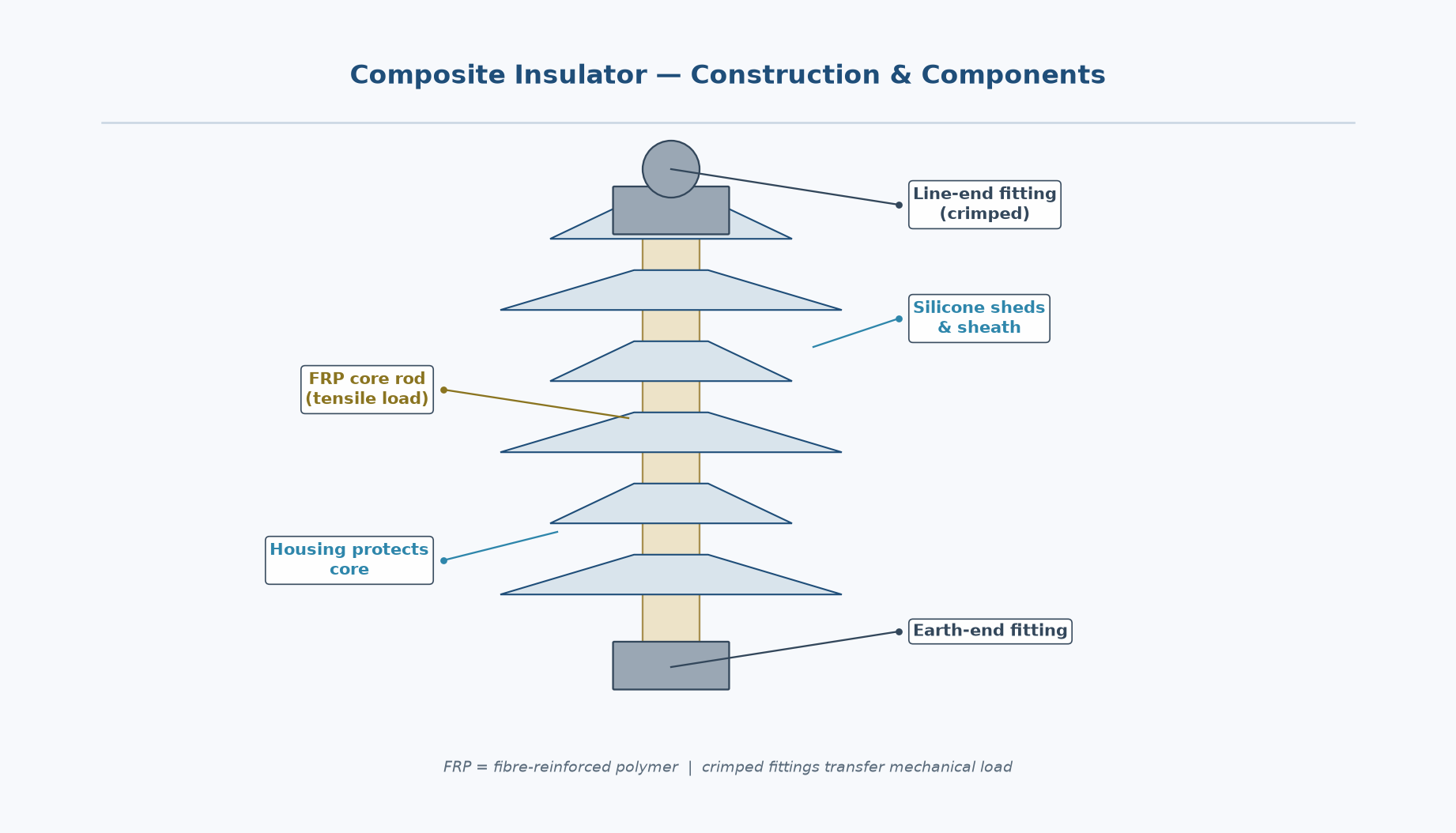
A composite insulator consists of three parts:
- Core (FRP rod) — a pultruded fiberglass-reinforced polymer rod that carries the tensile and bending mechanical load. It has very high tensile strength at a fraction of the weight of steel or porcelain.
- Housing / sheds — silicone rubber (or occasionally EPDM) moulded around the core. The sheds increase creepage distance and shed water.
- End fittings — metal (usually galvanised steel) terminations crimped onto the core, providing the connection to the line and structure.
Deep dive: → Polymer Insulator Technology & Design: How Silicone Rubber Composite Insulators Work
Why Silicone Rubber? Hydrophobicity & Pollution Performance
The decisive advantage of silicone rubber is hydrophobicity — its surface repels water. More importantly, silicone’s low-molecular-weight siloxanes migrate to the surface of an accumulated pollution layer, transferring hydrophobicity to the dirt itself. The result:
- Water forms isolated droplets instead of a continuous conductive film.
- Leakage current stays low even in coastal, desert, or industrial pollution.
- Flashover risk drops dramatically compared with hydrophilic porcelain, which becomes conductive when wet and dirty.
This is why composite insulators excel on lines running near coastlines, cement plants, or heavily polluted industrial corridors — locations where porcelain would need frequent washing.
Key Specifications & Ratings
When reading a composite insulator datasheet, focus on these:
| Parameter | Meaning | Selection note |
|---|---|---|
| SML | Specified Mechanical Load (kN) | Choose with safety margin above maximum conductor tension + wind/ice load |
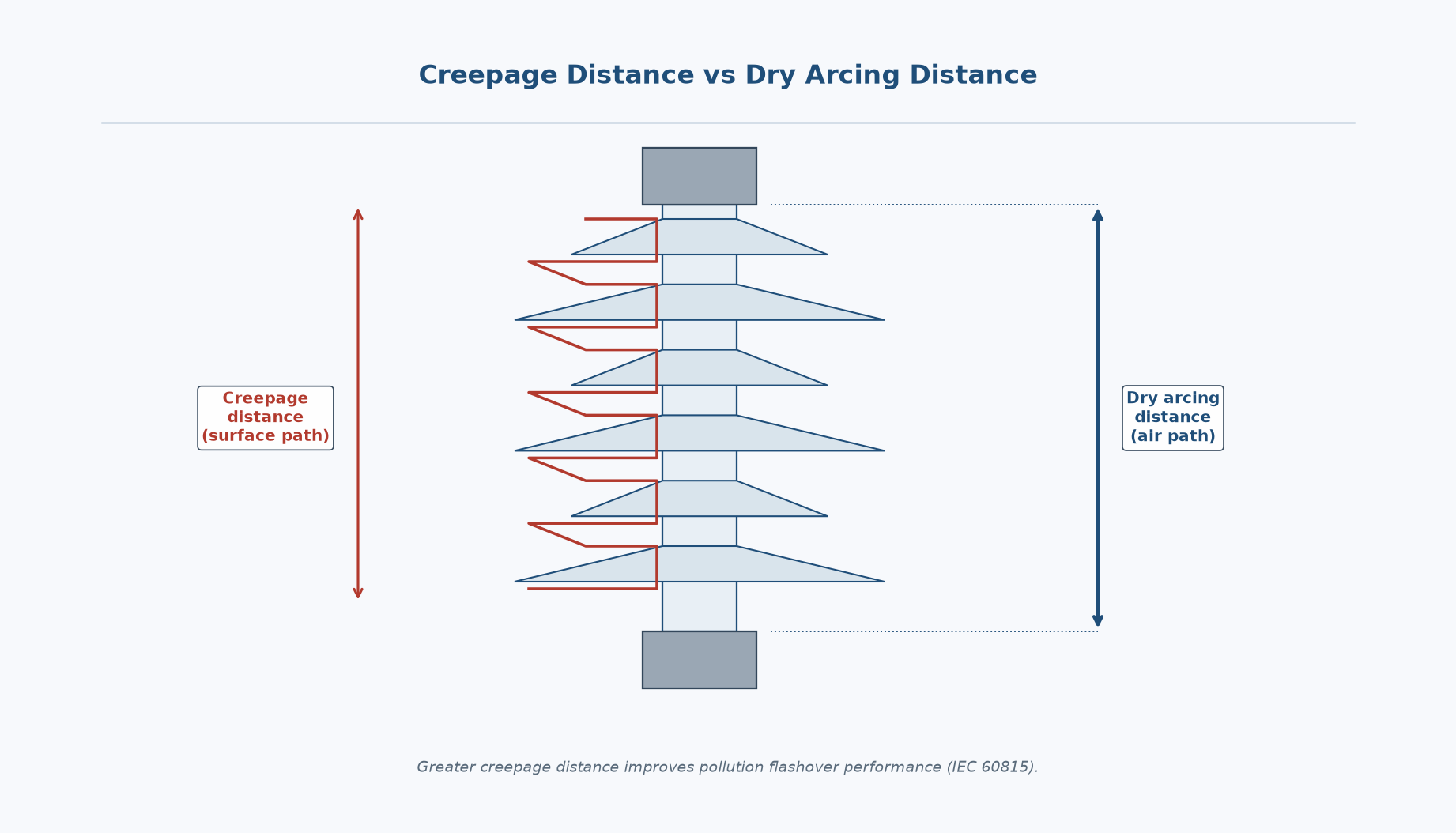
| Creepage distance | Surface path length (mm), often quoted as mm/kV | Match to pollution severity per IEC 60815 (16–31 mm/kV typical) |
| Dry arcing distance | Shortest air gap between fittings | Governs lightning impulse withstand |
| Rated voltage | System voltage class | 11/33/66/110/132 kV families |
| Impulse withstand | BIL (kV) | Must meet the insulation coordination level of the line |
Deep dive: → Polymer Insulator Selection Guide: Specifications, Ratings and Field Application
Standards & Type Testing
Composite insulators for AC overhead lines are governed primarily by IEC 61109 (silicone rubber / EPDM housed), with IEC 61952 covering composite line post insulators. Type tests verify:
- Mechanical: specified mechanical load (SML) test, tensile and bending strength
- Electrical: lightning impulse withstand, power-frequency withstand, puncture test
- Environmental: tracking and erosion resistance, UV weathering, water diffusion, housing/fitting integrity
- Interface: dye penetration or similar test to check the housing-to-fitting seal
Always request the type-test report from an accredited laboratory and confirm it covers your exact model and voltage class.
Deep dive: → Composite Insulator Type Tests: What the Standards Require
Composite vs Porcelain vs Glass: A Decision Table
| Factor | Composite (silicone) | Porcelain | Glass |
|---|---|---|---|
| Weight | Very light (easy handling/installation) | Heavy | Heavy |
| Pollution performance | Excellent (hydrophobic) | Poor when wet (needs washing) | Good (transparent, self-cleaning-ish) |
| Breakage / vandalism | Does not shatter | Can crack/shatter | Shatters (toughened glass) |
| Ageing | Good with quality compound | Excellent, century-long record | Excellent |
| Inspection | Harder to inspect internally | Mature methods | Visual (discolouration) |
| Cost | Competitive, best at HV | Higher installed cost | Low–medium |
Rule of thumb: choose composite where pollution, weight, or vandalism resistance dominate; porcelain/glass where a very long proven record and easy visual inspection matter most and pollution is mild.
Application by Voltage Level
- 11 kV / 33 kV distribution — pin-post and tension composite insulators; light weight speeds installation and reduces structure loading.
- 66 kV / 110 kV — suspension and tension strings; hydrophobicity pays off on long polluted corridors.
- 132 kV and above — composite long-rod and brake insulators; the weight advantage over porcelain becomes decisive for tower design.
Frequently Asked Questions
What are the three main components of a composite insulator?
A fiberglass-reinforced polymer (FRP) core rod that carries the mechanical load, a silicone rubber housing with sheds that provides insulation and hydrophobicity, and metal end fittings crimped to the core for connection.
Why is silicone rubber preferred for polymer insulator sheds?
Silicone rubber is inherently hydrophobic and transfers that hydrophobicity to accumulated pollution, keeping leakage current low and resisting flashover in wet, polluted, or coastal environments. It also resists tracking and erosion and will not shatter.
How do I calculate the required creepage distance for a polluted area?
Multiply the system’s line-to-line voltage by the recommended unified specific creepage distance for the pollution class (roughly 16–31 mm/kV per IEC 60815). Heavier pollution → higher mm/kV. Always confirm against your utility’s practice.
What does IEC 61109 require in composite insulator type tests?
IEC 61109 covers mechanical load tests, electrical impulse and power-frequency withstand, tracking/erosion and UV weathering, and interface seal integrity — all on the specific design and material system.
Are composite insulators suitable for 110kV and 132kV transmission lines?
Yes. Composite long-rod and suspension insulators are widely used at 110 kV and 132 kV and above. Their light weight and pollution performance are especially valuable at these voltages.
Request a Quote
XinNeng supplies composite pin post, suspension, tension and ABC fitting insulators for 11 kV–132 kV systems, with IEC 61109 type-test reports available.
→ Request a Quote: Contact our sales team or email xn@xin-neng.com
→ Browse products: Composite pin post insulators · All insulator products