
Surge arrester aging is invisible until failure — by the time degradation is evident, catastrophic failure may be imminent.
Table of Contents
- 1. How Aging Degrades Arrester Performance: The Progressive Failure Pathway
- 2. The Physical and Chemical Mechanisms Behind Arrester Aging
- 3. Extending Service Life: Monitoring, Maintenance, and Replacement Strategies
- 4. Thermal vs. Electrical vs. Environmental Aging: Impact Severity and Detection Methods
- 5. Summary
Key Points: What You’ll Learn
- Aging progresses through four distinct stages over a 30-year service life — resistive leakage current is the most sensitive early indicator, with 5 mA as the warning threshold and 10 mA as the critical replacement threshold.
- Electrical aging (ZnO Schottky barrier degradation via ionic migration and interface state generation) and thermal aging (positive feedback loop toward thermal runaway) are the primary mechanisms leading to catastrophic failure without external warning.
- Environmental aging of polymer housings (hydrophobicity loss, tracking, erosion, embrittlement) enables moisture ingress that accelerates electrical aging — hydrophobicity loss is partially reversible, but tracking damage is permanent and requires replacement.
- Combined multistress aging accelerates degradation by 2–5× compared to single-stress conditions, making multistress-rated arrester design and multiparameter monitoring essential for accurate service life prediction.
- A structured diagnostic program combining resistive current monitoring, thermal imaging, hydrophobicity classification, and partial discharge testing can extend service life to 25–30 years, with proactive replacement recommended at 25 years regardless of diagnostics.
1. How Aging Degrades Arrester Performance: The Progressive Failure Pathway
Polymer-housed metal-oxide surge arresters (MOSAs) have become the dominant protective device in modern power systems, replacing porcelain-housed units in most new installations. The polymer composite housing—typically silicone rubber (SIR) or EPDM weathersheds over an FRP core tube—offers superior light weight, hydrophobicity, and vandalism resistance. However, long-term reliability is governed by complex aging mechanisms affecting both the ZnO varistor blocks and the polymeric housing.
Aging is not a single process but a progression through distinct stages, each with detectable symptoms. Understanding this progression allows maintenance teams to intervene before catastrophic failure.
Stage I: Incubation (Years 0–10)
During the first 10 years of service, degradation is minimal. Leakage current remains below 0.5 mA, hydrophobicity is intact (HC class 1–2), and no external signs of aging are visible. The ZnO grain boundaries are stable under continuous operating voltage. This stage requires only routine visual inspection and baseline data collection.
Stage II: Degradation (Years 10–20)
Leakage current begins a slow rise as ZnO grain boundary barriers gradually degrade. The housing surface may show the first signs of hydrophobicity loss (HC class 3–4) in polluted or high-UV environments. Partial discharge activity may begin at the end-fitting/housing interface. This stage requires annual resistive current measurement and periodic thermal imaging.
Stage III: Accelerated Aging (Years 20–30)
Leakage current exceeds 1.0 mA, indicating significant ZnO block degradation. Tracking become visible on the housing surface. Cracks may develop in weathered weathersheds. The thermal runaway temperature threshold drops by 20–30°C, meaning the arrester can no longer safely withstand prolonged overvoltages. This stage requires immediate investigation and replacement planning.
Stage IV: End-of-Life (Failure Imminent)
Leakage current exceeds 2.0 mA. Thermal runaway can occur at normal operating temperature. Housing hydrophobicity is lost (HC class 5–7). Internal corrosion may be present. Replacement is urgent—continued operation risks explosive failure during the next major surge event.
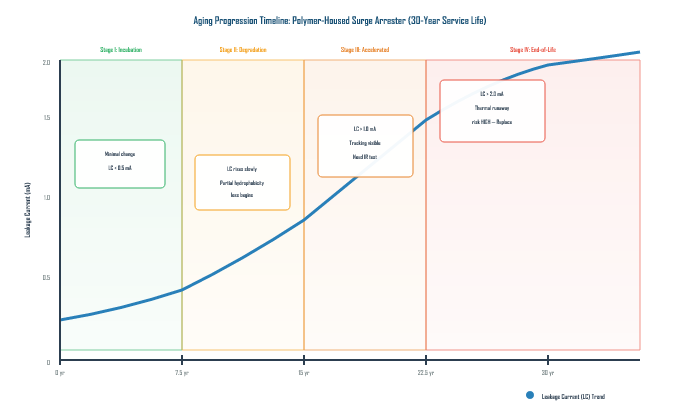
Figure 1: Aging progression timeline showing four distinct degradation stages over a typical 30-year service life. Leakage current is the primary diagnostic indicator.
2. The Physical and Chemical Mechanisms Behind Arrester Aging
Aging in polymer-housed surge arresters is never due to a single cause. Electrical stress, thermal cycling, and environmental exposure act simultaneously, creating synergistic effects that accelerate degradation. Understanding the underlying mechanisms is essential for selecting the right arrester design and interpreting diagnostic results.
Electrical Aging: ZnO Varistor Degradation
The core protective element is the metal-oxide varistor block, composed of ZnO grains with additive oxides (Bi₂O₃, Sb₂O₃, CoO, MnO, Cr₂O₃) that form intergranular Schottky barrier layers. These barriers create the highly nonlinear V-I characteristic. Under continuous operating voltage stress, three mechanisms progressively degrade the barriers:
- Ionic migration: At elevated temperatures and sustained electric field, metal ions (bismuth, antimony) migrate within grain boundary regions, reducing barrier height and width. This process follows an Arrhenius relationship with temperature.
- Interface state generation: High-energy carriers trapped at grain boundary interfaces create additional interface states, increasing leakage current at operating voltage and accelerating further degradation through increased power dissipation.
- Microstructural changes: Extended electrical stress induces changes in ZnO grain size distribution and continuity of intergranular oxide layers, altering the local composition and electrical properties of the grain boundaries.
Thermal Aging and Heat Runaway
Thermal aging is inextricably linked to electrical aging through a positive feedback loop: increased leakage current raises power dissipation, which raises temperature, which further increases leakage current. Heat runaway occurs when the power generated within the MOV blocks (Pgen = Vop × Ileakage) exceeds the power that can be dissipated to the environment (Pdiss). The condition for thermal stability is:
dPgen/dT < dPdiss/dT
When this condition is violated, the arrester enters thermal runaway—rapid temperature rise, melting of internal components, and eventual explosive failure. The critical temperature at which runaway occurs drops significantly as the arrester ages, from 90–110°C when new to 60–80°C at end-of-life.
Environmental Aging of Polymer Housing
The polymer housing is subjected to UV radiation, temperature cycling, humidity, pollution, and mechanical stress. Three mechanisms dominate:
- Hydrophobicity loss: UV radiation and heat cause migration of low-molecular-weight silicone fluid to the surface, then formation of polar silanol groups that increase surface energy. The contact angle drops from >90° (hydrophobic) to <30° (hydrophilic), allowing continuous water films to form and enabling surface leakage currents.
- Tracking and erosion: Electrical discharges in the presence of surface contamination create permanent conductive carbonaceous paths (tracking) and material loss (erosion). Both are accelerated by high pollution, sustained voltage stress under wet conditions, and inadequate creepage distance.
- Mechanical embrittlement: Polymer chain scission (UV-induced) or excessive cross-linking (thermal-induced) causes loss of elastomeric properties. Embrittled housings crack under thermal expansion/contraction cycles or mechanical stress.
Critical warning: Hydrophobicity loss is partially reversible in silicone rubber—low-molecular-weight fluid continues to migrate to the surface and can restore water-repellent properties if the stress source is removed. However, once tracking (carbonaceous paths) forms, the damage is permanent and the arrester should be replaced.
Multistress Aging Models for Life Prediction
Accurate service life prediction requires multistress models that account for the superposition of electrical, thermal, and environmental stresses. The combined model takes the form:
Lcombined = L0 × (V/V0)-n × exp[(Ea/k) × (1/T − 1/T0)] × f(H, UV, pollution)
Where L is service life, V is operating voltage stress ratio, n is the voltage endurance coefficient (20–40 for ZnO varistors), Ea is activation energy (0.8–1.2 eV for ZnO), and f(H, UV, pollution) is an empirical environmental function derived from accelerated weathering tests.
3. Extending Service Life: Monitoring, Maintenance, and Replacement Strategies
Maximizing surge arrester service life requires a three-pillar approach: selecting arresters with proven multistress-resistant designs, implementing periodic diagnostic testing, and applying statistical life prediction models to optimize replacement scheduling.
Diagnostic Field Testing Program
A structured diagnostic program detects aging before it becomes critical. The key tests, in recommended order of priority, are:
- Resistive leakage current measurement: The most sensitive online method. Modern digital arrester monitors provide continuous monitoring with configurable alarm thresholds. Establish baselines at installation; trend analysis detects degradation far earlier than absolute thresholds.
- Infrared thermography: Detects abnormal heating from elevated Ir or poor electrical connections. Perform annually and after major storms. Avoid rainy or high-wind conditions for reliable results.
- Hydrophobicity classification (HC): Visual or photographic assessment of water droplet behavior on the housing surface. HC classes 1–2: fully hydrophobic (good); classes 5–7: fully hydrophilic (replace).
- Partial discharge measurement: Detects internal voids, delamination, or corona activity. Essential for GIS-installed arresters where other diagnostic methods are impractical.
Condition-Based Replacement Criteria
Replace the arrester when any of the following conditions are met:
| Parameter | Replace at Next Outage | Replace Immediately |
|---|---|---|
| Resistive Current Ir | > 5 mA | > 10 mA |
| Third Harmonic I3ω | > 0.5 mA | > 1.0 mA |
| U1mA deviation | < −7% from original | < −15% from original |
| Thermal ΔT (from ambient) | > 15°C | > 30°C |
| Hydrophobicity class | HC 4–5 | HC 6–7 (fully wetting) |
| Age (regardless of diagnostics) | > 25 years | > 30 years |
Material Selection for Extended Service Life
When procuring new arresters, specify materials proven for long-term outdoor service:
- Housing material: High-quality silicone rubber (SIR) with proven hydrophobicity recovery characteristics outperforms EPDM in most environments. Request material formulation details and accelerated weathering test reports from the manufacturer.
- End-fitting seal design: Dual-seal arrangements (elastomeric + adhesive) provide superior long-term moisture ingress protection compared to single-seal designs.
- FRP core tube quality: The fiberglass core tube must be compatible with the housing material to avoid interface debonding under thermal cycling. Specify thermally matched core/housing pairs.
Service life optimization checklist:
- Specify station-class polymer-housed arresters with high-quality SIR weathersheds and dual-seal end fittings.
- Record baseline resistive current and third-harmonic values at installation for every arrester.
- Perform annual online monitoring; perform offline U1mA testing every 5–10 years during outages.
- Replace arresters proactively at 25 years of service, or earlier if diagnostic thresholds are exceeded.
- For coastal or high-pollution areas, increase diagnostic frequency and consider more frequent replacement (15–20 year cycle).
4. Thermal vs. Electrical vs. Environmental Aging: Impact Severity and Detection Methods
Not all aging mechanisms are equally dangerous or equally detectable. The following comparison helps prioritize diagnostic efforts and replacement planning based on the dominant aging mechanism in your operating environment.
| Aging Mechanism | Primary Cause | Impact Severity | Detection Method | Mitigation Strategy |
|---|---|---|---|---|
| Electrical Aging (ZnO varistor degradation) | Continuous operating voltage stress, surge energy absorption history | High — leads to thermal runaway and explosive failure | Resistive leakage current, third-harmonic analysis, U1mA drift | Select appropriate MCOV rating; limit surge energy; condition-based replacement |
| Thermal Aging (Heat runaway pathway) | Elevated operating temperature, high leakage current, poor heat dissipation | High — causes rapid, catastrophic failure without warning | Thermal imaging, power loss measurement at operating voltage | Ensure adequate clearance for heat dissipation; avoid overvoltage operation |
| Environmental Aging (Housing degradation) | UV radiation, pollution, humidity, temperature cycling | Medium — leads to moisture ingress, tracking, and internal corrosion | Hydrophobicity classification, visual inspection, partial discharge | Specify high-quality SIR housing; increase creepage distance in polluted areas |
| Mechanical Aging (Interface/seal degradation) | Thermal cycling, vibration, improper installation | Medium — causes moisture ingress and internal corrosion | Insulation resistance test, visual inspection of seals | Dual-seal end-fitting design; proper torque during installation |
| Combined Multistress (Synergistic effects) | Superposition of electrical + thermal + environmental stresses | Very High — accelerates aging by 2–5× compared to single stress | Multiparameter monitoring (Ir + thermal + housing condition) | Multistress-rated arrester design; comprehensive CBM program |
Key insight: Electrical and thermal aging are the most urgent threats because they can lead to explosive failure without external warning signs. Environmental aging, while slower, compromises the housing and eventually enables moisture ingress that accelerates electrical aging. A comprehensive maintenance program must address all three mechanisms with targeted diagnostic methods.
5. Summary
- Pain point: Surge arrester aging is invisible until failure — by the time degradation is evident, catastrophic failure may be imminent.
- Finding 1: Aging progresses through four stages over a 30-year service life, with resistive leakage current being the most sensitive early indicator of ZnO varistor degradation.
- Finding 2: Electrical aging (Schottky barrier degradation) and thermal aging (positive feedback loop toward thermal runaway) are the primary mechanisms leading to catastrophic failure, while environmental aging of the polymer housing enables moisture ingress that accelerates both.
- Finding 3: A structured diagnostic program combining online resistive current monitoring, periodic thermal imaging, and multistress-resistant arrester selection can extend service life to 25–30 years with a high degree of reliability.
- Comparison conclusion: Electrical and thermal aging pose the highest risk and require continuous or frequent online monitoring; environmental aging is detectable through periodic visual inspection and hydrophobicity assessment; a multistress approach is essential for accurate life prediction.
Get Your Custom Surge Arrester Solution
Concerned about arrester aging in your system? Our engineering team provides arrester life assessment, diagnostic program design, and replacement planning tailored to your operating environment.
Or visit www.xin-neng.com to browse our full product catalog.
About Xin-Neng Electric
Xin-Neng Electric is a leading manufacturer of high-voltage electrical equipment, specializing in surge arresters, drop-out fuse cutouts, and composite insulators for power transmission and distribution systems worldwide.
Contact: xn@xin-neng.com | www.xin-neng.com
Frequently Asked Questions
How does aging degrade surge arrester performance?
Aging progressively raises leakage current and reduces energy capability through varistor degradation, housing weathering, and seal loss – following a pathway from minor parameter drift to thermal runaway.
What physical and chemical mechanisms drive arrester aging?
Moisture ingress, UV and thermal cycling of the housing, and electrochemical changes in the ZnO varistor block are the primary mechanisms.
How can I extend a polymer-housed arrester’s service life?
Monitor resistive leakage current, keep seals intact, avoid exceeding TOV and energy duty, and replace units showing significant parameter drift.
Which aging type is most severe – thermal, electrical, or environmental?
Electrical/thermal aging (varistor degradation) is most directly dangerous because it can lead to thermal runaway; environmental aging (housing) is slower but erodes hydrophobicity and sealing.